Beer contains approximately 90% water, and the importance of the liquor to final beer quality cannot be over-estimated.
The water supplied by local Water Authorities is required to be potable – that is fit to drink and free from pathogenic organisms. In order to reduce microbiological counts chlorine will usually be added, but the water is not sterile. Fortunately however the micro organisms found in water are not beer spoilage organisms, being unable to survive the conditions of high ethanol and hop resin levels and low pH found in beers. So the objective of liquor treatment is to convert the water sent to us by the Water Authorities into acceptable brewing liquor. This we achieve by the removal of unwanted ions and addition of required levels of desirable ions
| Ion | Soft | Hard |
| Calcium | 10 | 240 |
| Magnesium | 2 | 50 |
| Bicarbonate | 15 | 250 |
| Sulphate | 5 | 500 |
| Nitrate | 5 | 40 |
| Chloride | 5 | 50 |
| All figures in mgs per litre (ppm) | ||
Calcium
Of the ions required for brewing, calcium is by far the most important. This is because of the acidifying effect that calcium has on the wort.
 Wort contains large amounts of phosphates derived from the malt, and these have a buffering effect – that is they tend to mop up hydrogen ions and keep the pH higher than desired. Calcium ions precipitate phosphates as insoluble calcium phosphate and release hydrogen ions into the wort. It is worth mentioning at this point that whilst the pH of the wort is critical, that of the water in the Hot Liquor Tank (HLT) is not. The pH of water may vary from about pH 5 to pH 8 dependent upon the levels of dissolved carbon dioxide – even de-ionised water can have pH levels as low as 5 after exposure to the air. However, the carbon dioxide is driven off by heat in the HLT and the pH of the water will rise.
A combination of the presence of calcium ions and the decrease in pH has a number of effects on the brewing process: the lower pH improves enzyme activity and thus wort fermentability and extract.
The optimum pH for ß-amylase activity is about 4·7. Wort produced from liquor containing no calcium has a pH in the order of 5·8 – 6·0, compared to values in the range of 5·3 – 5·5 for worts produced from treated brewing liquor. The activity of the ß-amylase then is greatly enhanced by the addition of calcium, this exo enzyme increasing the production of maltose from Amylose, and thus making worts more fermentable.
Calcium has an almost ‘chicken and egg’ effect in the precipitation of wort proteins, both during mashing and during the boil.
Protein-H + Ca2+  Protein-Ca + 2H+
The hydrogen ions released further reduce the pH which encourages further precipitation of proteins. Proteins are also degraded, that is converted to simpler substances by proteolytic enzymes called proteases. These are found in the malt, and have optimum activity at pH values of about 4·5 – 5·0. The reduction in pH then caused by the presence of calcium encourages proteolysis, further reducing protein levels and increasing wort Free Amino Nitrogen levels (FAN). FAN compounds are utilised by the yeast during fermentation for the manufacture of Amino acids, and an increase in FAN levels in the wort improves the health and vigour of the yeast. High protein levels in beers also have negative effects, making beer more difficult to fine and encouraging formation of hazes, in particular chill hazes. Product shelf life can also be adversely affected.
Calcium ions protect the enzyme a-amylase from inhibition by heat. a-amylase is an endo enzyme, cleaving the internal 1,4 glucosidic links of amylopectin resulting in a rapid reduction in wort viscosity. The optimum temperature range for a-amylase is 65 – 68°C., however the enzyme is rapidly destroyed at these temperatures. Calcium stabilises a-amylase to 70 – 75°C.
It can be seen then that the presence of calcium has positive effects on the activity of both a-amylase and ß-amylase, two of the most important enzymes in the brewing process.
- The drop in pH encouraged by Calcium ions in the mash and copper helps afford the wort and subsequent beer produced a greater resistance to microbiological infection.
- The reduced pH of the sparge liquor reduces extraction of undesirable silicates, tannins and polyphenols from the mash bed.
The extraction of such materials is encouraged by alkaline sparge liquor. These materials are very undesirable, contributing to harsh flavours, hazes in the finished beer and decreased beer stability.
Calcium precipitates oxalates as insoluble calcium oxalate. This again occurs in both the mash tun and the copper. Oxalates cause hazes in finished beers and also contribute to the formation of beerstone in FV’s, CT’s and casks. Oxalates are also thought to promote gushing in certain beers, although this is not generally a problem to the micro brewer.
The presence of calcium reduces colour formation in the copper. This is due to the reduction of extraction of colour forming compounds such as anthocyanogens and pro-anthocyanidins during the sparge.
The reaction: Reducing Sugar + Heat Melanoidins is also inhibited.
Calcium ions improve beer fining performance. Calcium ions encourage yeast flocculation – being a divalent Cation it has a natural affinity for negatively charged yeast cells.
With all the above advantages of the presence of calcium and reduction in pH there is one minor disadvantage: the reduction in pH causes a decrease in hop utilisation, giving less bitter beers. This increases hopping costs, since more hops will be required to achieve a desired level of bitterness. However the optimum pH for hop isomerisation as used in the commercial production of isomerised hop extracts is about pH 10, so a reduction from pH 5·8 in a mash with untreated liquor to pH 5·1 out of copper for a treated brew is not too critical.
You will see that much of the calcium added to the mash is lost – precipitated out as phosphate, proteinate or oxalate. Since calcium is specifically required in the copper for further precipitation of these materials it is common to add calcium to the grist or Hot Liquor Tank and to then make a second addition to the copper. Where this is not practical it is quite acceptable to make a larger addition to the grist or to the H.L.T.
Bicarbonate (Alkalinity)
This ion needs to be very closely controlled in order to achieve good beer. High levels of bicarbonate cause high pH values throughout the brewing process according to the equation:
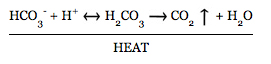 It should be noted that bicarbonate ions are rather more effective at raising wort pH than calcium ions are at reducing it.
The conversion of bicarbonate to carbonic acid is reversible until heat is applied, which drives off the carbon dioxide. This effectively removes the acidic hydrogen ion from the system by using it to form a stable water molecule. The wort pH therefore remains high and all the advantages derived from the presence of adequate calcium levels and reduced pH are lost.
We therefore see the following:
- Harsh after-tastes in the finished beer
- Extract will be reduced due to lower ß-amylase activity
- Reduced protein precipitation due to high pH
- Worts and beer more prone to infection
- Increased extract of undesirable materials in the sparge, notably silicates, polyphenols and tannins
- Hop utilisation will also be increased, giving more bitter beers.
The net result of this is then to decrease beer stability and shelf life and to increase the likelihood of troublesome hazes. Colour will be darker, and flavour will be detrimentally affected. It is then also essential to ensure removal of excess bicarbonate. As shown in the table at the top of this article, hard water may contain 250 mgs/l of bicarbonate. However, the maximum level that can be tolerated without adverse effect for the production of pale ales is 50 mgs/l and the preferred level would be about 25 mgs/l. It should also be noted that whilst additions of calcium may be made to HLT, grist and copper, the removal of bicarbonate must be achieved in the Hot Liquor Tank.
This may be done in a number of ways:
Deionsiation: Very effective, but high capital and revenue costs.
Lime treatment: Addition of carefully controlled amounts of lime (calcium hydroxide) to the HLT will precipitate the bicarbonate as calcium carbonate. There are 2 major drawbacks:
1. The amount added needs to be exactly calculated and over addition may result in an overall increase in alkalinity.
2. The precipitated calcium carbonate can form a sludge on the bottom of the HLT that will need periodic cleaning.
Boiling: This again is a traditional method of removal of bicarbonate (Temporary Hardness) but again has 2 drawbacks:
1. Very expensive.
2. Only effective where the alkalinity is present as bicarbonate. If the levels of sodium, potassium or magnesium carbonates or hydroxides present are significant boiling will not be effective.
Acid Treatment: Now the most widely used method, for a number of reasons:
1. Relatively inexpensive.
2. Easy to use and does not produce sludge in the HLT
3. May add desirable anions – sulphate or chloride.
4. Can use phosphoric or lactic acids if no anions are wanted – eg for lager beers.
It is essential to rouse the liquor when acid treating in order to encourage the removal of the carbon dioxide. This can have corrosive effects on the materials of construction of HLT’s if left in solution.
Magnesium:
Is an essential element of brewing liquor because it is required by yeast as a co-factor for the production of certain enzymes required for the fermentation process. It is invariable formulated into liquor treatments at relatively low levels.
However caution must be exercised for 3 reasons:
1. Excess magnesium can interfere with the reactions of calcium because its phosphates are more soluble
2. Above about 20 mgs/l magnesium can give beer a sour and bitter taste
3. In excess magnesium has a laxative effect
Sodium:
Is present in all beers. Excessive levels are undesirable as it imparts a sour and salty taste at high concentrations. The flavour is more acceptable when the sodium is present as chloride than as sulphate.
Potassium:
Is, like magnesium, a yeast co-factor and is required at trace levels for satisfactory fermentations. It is more acceptable than sodium from a flavour point of view, giving a salty taste without the sour notes. It is also gaining some favour as Doctors warn of the effects of high sodium intake on blood pressure. However potassium salts are very much more expensive than the sodium equivalents, and in excess potassium has laxative effects on the beer.
Sulphate and Chloride:
It is convenient to discuss the effect of these two ions together. Much is made in brewing literature of the impact of these ions on beer flavour characteristics – sulphate gives beer a drier, more bitter flavour, whilst chloride imparts palate fullness and to an extent sweetness. However what must be noted is that it is the ratio of the concentrations of these two ions that is significant, rather than simply the actual concentrations. A ratio of about 2:1 sulphate to chloride is about right for a bitter beer, and it makes little difference if the actual values are 500:250 or 350:175 mgs/l. As will be seen in Figure 3 ratios of 1:2 sulphate:chloride are recommended for mild ales, whilst a ratio of 1:3 may give best results for stouts or porters.
Sulphate and Chloride, it is convenient to discuss the effect of these two ions together. Much is made in brewing literature of the impact of these ions on beer flavour characteristics – sulphate gives beer a drier, more bitter flavour, whilst chloride imparts palate fullness and to an extent sweetness. However what must be noted is that it is the ratio of the concentrations of these two ions that is significant, rather than simply the actual concentrations. A ratio of about 2:1 sulphate to chloride is about right for a bitter beer, and it makes little difference if the actual values are 500:250 or 350:175 mgs/l. As will be seen in Figure 3 ratios of 1:2 sulphate:chloride are recommended for mild ales, whilst a ratio of 1:3 may give best results for stouts or porters.
Sulphur is essential for the fermentation process, since the yeast needs to manufacture the two sulphur containing amino acids, cysteine and methionine. Some yeast strains will use sulphur from sulphate ions for this purpose and will then excrete any excess as sulphite ions. These can then be reduced to form hydrogen sulphide or sulphur dioxide. Both of these materials have characteristic pungent odours and even at low levels can give unacceptable sulphury noses to the beer. Bacteria also have the ability to produce a wide variety of sulphury off flavours, including rubber, garlic and cooked vegetable.
Nitrate:
Levels of Nitrate are beginning to drop generally due to greater control of the use of nitrogenous fertilisers. Nitrates themselves are not a problem at levels below 50 mgs/l, however they can be reduced by yeast or bacteria to form Nitrites. These ions can then react with wort amines to form Nitrosamines, which are carcinogenic.
Trace Ions:
- Metals such as Iron, Manganese, Copper and Zinc may be found in small quantities in water and are all utilised by yeast at levels below 1 ppm. Higher levels can cause colloidal hazes and metallic off flavours, particularly with higher levels of Iron. High levels of heavy metals can also be toxic to yeast.
- Silica should also be at very low levels in brewing liquor because of the likelihood of colloidal hazes being formed.
- Ammonia should be absent in brewing liquors, being indicative of contamination by sewage.
- Fluorine, present in most waters at about 1 ppm for dental purposes, has no detectable effect on the brewing process.
Chlorine
Chlorine is used for sterilisation and may be at relatively high levels at certain times of the year. This can cause problems since chlorine is a very reactive chemical and will readily react with organics to form chlorophenols. These have a medicinal (T.C.P.) flavour which is in some cases detectable at levels below 1 ppb. Chlorine will be lost to some degree by the heat in the Hot Liquor Tank, but not all water used within the brewery is from that source. Some brewers may use untreated liquor to break down to gravity in fermenter, and rinsing following caustic or acid cleaning cycles will typically be with untreated mains liquor. One solution is to treat both Hot and Cold Liquor Tanks with 10 ppm of Salicon Liquid 169 (20 mls in 10 brls liquor) and rouse vigorously to remove the chlorine. The sulphur dioxide reacts with chlorine in the manner described below – reducing reactive, undesirable and potentially harmful chlorine ions to chlorides.

| Typical Liquor Analyses for Beer Types: | ||||
| Bitter | Mild | Porter | Lager | |
| Calcium | 170 | 100 | 100 | 50 |
| Magnesium | 15 | 10 | 10 | 2 |
| Bicarbonate | 25 | 50 | 100 | 25 |
| Chloride | 200 | 200 | 300 | 10 |
| Sulphate | 400 | 150 | 100 | 10 |
Nitrate – As low as possible
Metals – Zn, Cu, Fe,Mn Less than 1 ppm All figures are in ppm (mgs/ltr)